Saturn’s New Decagon Is Weather, Not Architecture
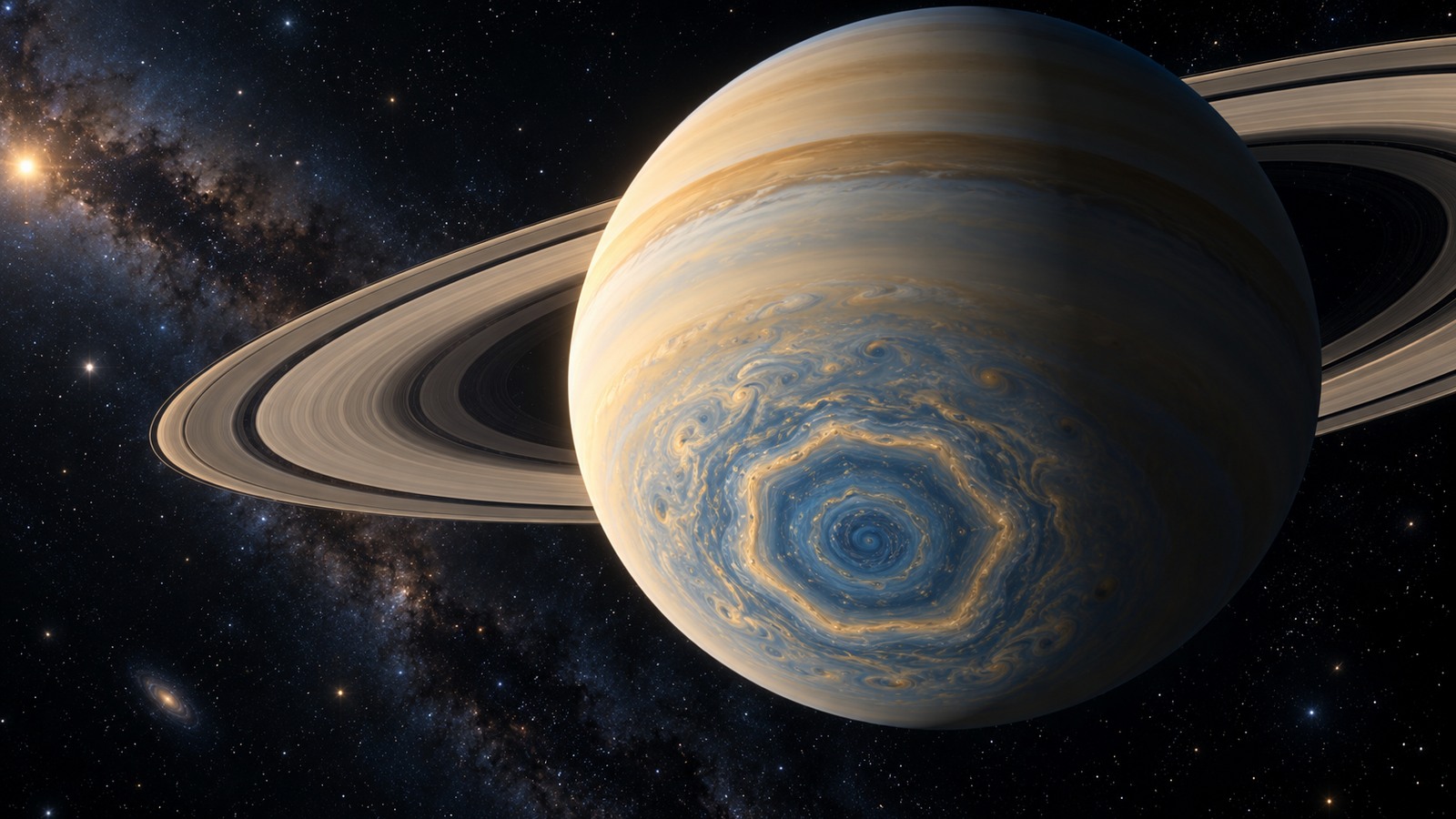
Hubble has revealed a ten-sided wave around Saturn’s south pole. Its geometry is striking, but the deeper discovery is that astronomers may be watching a giant atmospheric pattern take shape.
In short
What happened. Hubble observations have revealed a giant, evolving, ten-sided atmospheric wave around Saturn’s south pole. Researchers traced faint signs back to 2023 and saw the shape become clearer in later images.
What it means. The decagon is not a solid object or a ten-sided storm wall. It is a wave embedded in a fast jet stream, extending through several atmospheric layers. Astronomers may be seeing a planetary-scale pattern develop rather than discovering an ancient feature that was simply overlooked.
Risks and impact. The finding does not change anything dangerous on Earth. Its value is scientific: it offers a rare test of how rotation, jets, vortices and seasons organize weather on giant planets.
What can be done. Readers can follow the next Hubble observations and compare images by date and wavelength instead of treating one dramatic picture as a finished explanation.
What to watch. The decisive question is whether the ten-sided pattern stabilizes like Saturn’s long-lived northern hexagon, keeps changing or fades.
Shown as a summary because of your reading settings.
What happened
Saturn already had the Solar System’s most famous piece of geometric weather: a six-sided jet around its north pole. Now the planet has supplied a sequel. On September 2, researchers reported a blue, ten-sided wave encircling the south polar region.
The NASA Hubble team says this is the first large, regular-sided jet pattern observed in Saturn’s southern hemisphere. It appeared in Hubble images taken through the Outer Planet Atmospheres Legacy program, or OPAL, which has photographed the outer planets annually for more than a decade.
The first clue did not come from Hubble. Agustín Sánchez-Lavega of the University of the Basque Country and amateur astronomers Trevor Barry and Jean-Paul Oger noticed a subtle wave in ground-based images contributed to the Planetary Virtual Observatory Laboratory in 2024. Images from 2025 made the decagonal outline more persuasive. The team then examined Hubble observations and traced a weaker version back to 2023.
The pattern sits near 63 degrees south latitude. Different filters, which sample different heights in Saturn’s atmosphere, show that it is vertically extended rather than painted onto one cloud deck. UC Berkeley’s Space Sciences Laboratory reports winds associated with the jet at roughly 400 kilometres per hour.
What the evidence supports
The most convincing evidence is not that one image resembles a ten-sided coin. It is that the pattern appears across observations, dates and wavelengths.
Ground-based contributors first found the disturbance. Hubble then supplied sharper views across complete rotations of Saturn, without the blurring caused by Earth’s atmosphere. The team projected the planet’s curved southern region into a polar map, making the wave easier to compare. Images from 2023, 2024 and 2025 show the outline becoming more distinct. Filters centred on different wavelengths place the signal at different atmospheric heights.
That does not yet explain the mechanism. Sánchez-Lavega used a shallow-water model—a simplified way to represent a flowing atmospheric layer—to show that a decagonal wave can arise in turbulent fluid. The model demonstrates plausibility, not a complete diagnosis of Saturn.
A compact anticyclonic vortex just north of the decagon is one possible trigger. It was visible in 2023 and darkened substantially by 2025. The researchers suggest it may have disturbed the jet, after which the balance between pressure, rotation and flow allowed the wave to persist. Michael Wong of Berkeley describes that as a possibility requiring much more detailed three-dimensional simulation.
The ESA/Hubble release is explicit about what remains unknown: how the decagon formed, how long it will last and how it compares with the northern hexagon. The aerosol particles that give the region its blue colour are also not yet identified.
How the story is being framed
The tempting frame is “another perfect shape found in space.” It captures attention because nature looks as if it has borrowed a ruler. But “perfect” is doing too much work. The outline is a moving atmospheric wave, not a machined polygon, and its sides vary as the feature evolves.
A second frame treats the decagon as the southern twin of Saturn’s northern hexagon. The comparison is useful. Both involve waves constrained by powerful east–west jets on a rapidly rotating planet. Yet the differences may matter more. The northern hexagon has been visible since the Voyager encounters of 1980 and 1981. The southern decagon appears less stable and drifts relative to the surrounding atmosphere.
A third frame says Hubble “discovered” the feature. That is true in the sense that its images confirmed and characterized it, but it hides the chain of observation. Amateur contributors noticed the first clue in a shared planetary-image archive; professional researchers recognized its significance; Hubble delivered the resolution needed to test it. The discovery belongs to a system of patient looking.
Finally, it is possible that the feature is not new at all, only newly visible. Science News explains the observational gap: Cassini ended its mission in 2017, and Saturn’s south pole had been turning away from Earth since 2012 before returning to view in 2023. The available record supports “recently emerged,” but cannot supply a precise birthday.
The background
Saturn rotates once in roughly 10.7 hours. That rapid spin strongly deflects north–south motion, organizing the atmosphere into east–west bands. Warm gas cannot simply travel in a straight line from equator to pole; rotation bends its path. On a large, fast-spinning world, jets are the normal result.
Polygonal jets are stranger. A smooth current can begin to meander as waves grow along its boundary. Under the right relationship between flow speed, latitude and neighbouring vortices, the bends can settle into a repeating pattern. Laboratory experiments with rotating tanks have produced polygons, including hexagons. The experiment does not shrink Saturn into a bowl. It shows that corners can emerge from fluid motion without solid walls.
The northern hexagon is about as enduring as atmospheric landmarks come. Voyager saw it more than four decades ago, Cassini studied it closely, and Hubble still tracks it. Its colour changed with Saturn’s seasons, from blue to golden tones and back toward blue, while the basic wave remained.
The south did not cooperate with the expected symmetry. Cassini imaged the southern hemisphere from 2004 onward and found short-lived polygon-like disturbances, but no persistent counterpart. Then Cassini plunged into Saturn in September 2017. OPAL’s regular Hubble visits became especially valuable because they turned occasional portraits into a time series.
That is the central context for the new finding. Astronomers are not merely adding “decagon” to Saturn’s list of curiosities. They have recovered the early chapters of a weather system because somebody kept taking comparable pictures before anyone knew what the pictures would contain.
Who it touches
The route from faint wiggle to published result crossed the usual boundary between amateur and professional astronomy.
The Planetary Virtual Observatory Laboratory accepts images made by observers around the world. Trevor Barry and Jean-Paul Oger contributed ground-based views in which Sánchez-Lavega noticed the southern disturbance. Those pictures did not have Hubble’s sharpness, but they supplied the alert and the chronology.
Amy Simon at NASA Goddard leads OPAL. Wong, a co-author at Berkeley, helped establish the case for annual Hubble surveys after gaps in observations made it harder to understand changes on the outer planets. Their program is designed around an unfashionable scientific virtue: return to the same place, with comparable instruments, and let time reveal the event.
No single observer could have planned the discovery in advance. The professionals provided continuity and analysis; skilled amateurs widened the watch; a telescope launched in 1990 supplied the stable platform. Wonder arrived through maintenance.
The deeper story
A photograph freezes Saturn into a decorative object: rings, stripes and a neat blue polygon. Weather is the opposite. It is motion that happens to look still because the exposure is brief.
The decagon is a useful lesson in how science handles that mismatch. A picture can establish that something exists, but a sequence asks what it is doing. Different colours of light reveal different heights. Old observations constrain when the feature might have appeared. A model tests whether known physics can produce the shape. An outside researcher can point out where a pleasing explanation outruns the evidence.
There is a practical way to read discoveries like this. Start with four columns: observed, inferred, proposed and unknown. Hubble observed a ten-sided pattern at multiple wavelengths. Researchers infer that it is a vertically extended wave within a jet. They propose that a nearby vortex may have triggered it. They do not know its exact birth date, deep structure, chemical colouring or lifespan.
That simple separation protects wonder from exaggeration. Mystery does not mean that anything is possible. Explanation does not mean the case is closed.
Hubble was scheduled to look at Saturn again later in September 2026. Webb observations and more detailed modelling may follow. If the shape strengthens, drifts, changes its number of sides or disappears, each outcome will prune a different set of explanations.
The remarkable thing is not that Saturn obeys geometry. It is that a restless fluid planet can briefly make geometry visible—and that a decades-old observing program was patient enough to catch the lines while they formed.
Something to sit with
What changes when a scientific image is treated as one frame in a film rather than as a finished portrait?
Which discoveries around us are missed because nobody keeps making the same careful measurement after the first excitement has passed?
Sources
- NASA Science — Hubble Tracks New Decagon Encircling Saturn’s South Pole — https://science.nasa.gov/missions/hubble/nasas-hubble-tracks-new-de...
- ESA/Hubble — Hubble tracks new decagon encircling Saturn’s south pole — https://esahubble.org/news/heic2612/
- UC Berkeley Space Sciences Laboratory — https://www.ssl.berkeley.edu/decagon-wave-emerges-near-saturns-south-pole/
- Science News — https://www.sciencenews.org/article/hubble-decagon-saturn-south-pole
We report facts from the sources above in our own words and link to the originals. Interpretation is ours, not theirs.
Why can’t astronomers yet say exactly when Saturn’s southern decagon formed?
Cassini’s mission ended in 2017, while Saturn’s seasons kept the south pole turned away from useful Earth-based viewing until it returned to view in 2023.
♻︎ Free to republish
Copy this HTML into your CMS. Credit line and licence are included. Republish our work — free
Every headline has a deeper story. This is ours.
What we are doing here