The Manuscript We Still Cannot Read—and What We Actually Know
The Voynich Manuscript attracts confident solutions because its pictures invite stories; a real decipherment would have to survive tests that pictures alone cannot pass.
In short
What happened. The Voynich Manuscript remains unread despite recurring claims that its strange script has finally been decoded.
What it means. Researchers know a surprising amount about the physical book, its provenance and patterns in its writing. None of that yet supplies a dependable translation.
Risks and impact. The practical risk is not the manuscript itself. It is mistaking an attractive interpretation, especially one matched to a suggestive drawing, for a method that explains the whole object.
What can be done. Ask whether a proposed solution uses stable rules, works on unseen pages, explains awkward passages and can be repeated by researchers who did not invent it.
What to watch. A genuine breakthrough would produce independent agreement from manuscript specialists, linguists and cryptanalysts—not merely a new headline, a fluent AI output or a few persuasive examples.
Shown as a summary because of your reading settings.
What happened
Open the digitised Voynich Manuscript and the temptation begins almost immediately. There are plants that seem familiar until they do not, circular astronomical diagrams, bathing figures, jars and rows of compact writing in a script found nowhere else.
The book is held by Yale’s Beinecke Rare Book and Manuscript Library as MS 408. Yale describes it as an illustrated codex written in an unidentified script by an unknown author. Scientific testing places its materials consistently in the fifteenth-century manuscript world. Its documented trail includes Emperor Rudolf II, several seventeenth-century scholars, the bookseller Wilfrid Voynich and, from 1969, the Beinecke Library.
The text has not been deciphered. That sentence matters because proposed solutions have appeared for decades.
Paleographer Lisa Fagin Davis has identified five scribal hands rather than one, a finding based on small, repeated differences in how characters were formed. That tells us the manuscript was probably a collaborative production. It does not tell us what the characters mean.
The library has made high-resolution images available online. Anyone can inspect the evidence. The mystery is open; the answer is not.
What the evidence supports
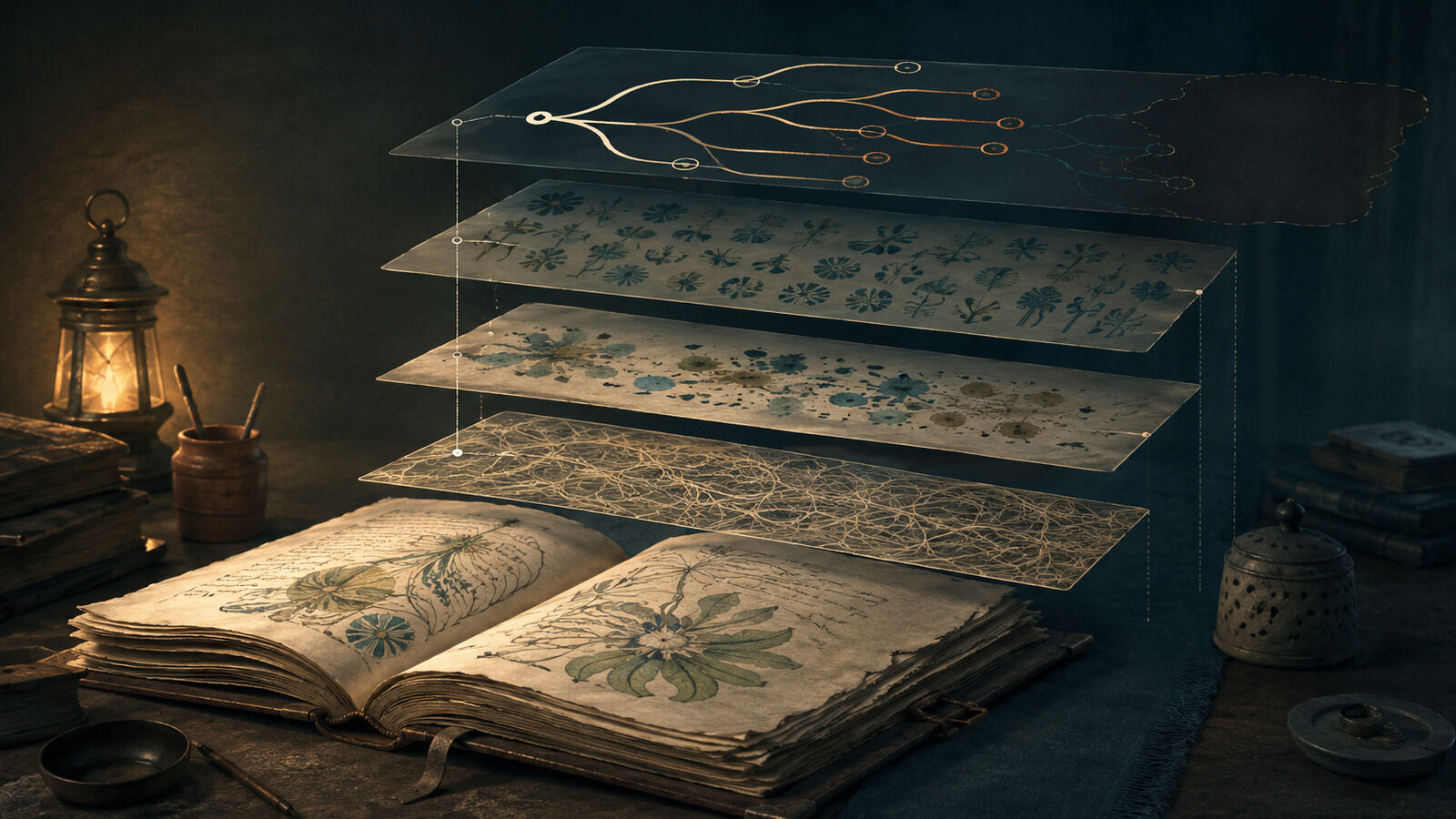
The evidence comes in layers, and each layer answers a different question.
The parchment, inks, pigments, binding and construction tell researchers about the object. Material consistency with fifteenth-century manuscripts makes a modern fabrication implausible. Provenance documents show where the book appeared in later centuries. Neither kind of evidence translates a sentence.
Paleography—the study of historical handwriting—can compare letter forms, writing habits and scribal hands. Davis’s five-scribe analysis is important because it changes the picture of production: several people appear to have worked within a shared writing system. It still cannot decide whether that system records a natural language, a cipher, an invented notation or something else.
Statistical work can show that symbols and words have non-random distributions. But structured output is not automatically meaningful language. Rules can generate patterns; copying conventions can generate patterns; a cipher can preserve or transform patterns.
What remains missing is the bridge from pattern to meaning. No published method has yet persuaded the relevant independent specialists that it translates substantial, varied portions of the manuscript consistently.
How the story is being framed
Three serious frames help explain why the argument keeps returning.
The first treats the manuscript as encoded language. This frame correctly notices repetition, position-dependent symbols and word-like regularities. Its weakness appears when a proposed key needs frequent exceptions, changing values or selective pages.
The second treats it as an unknown or constructed language. That can explain why conventional cryptanalysis struggles, and collaboration among several scribes makes a shared system conceivable. But possibility is not identification. Naming a language family after matching a handful of shapes or words is not enough.
The third asks whether the text may be generated notation or elaborate pseudo-writing rather than ordinary prose. That frame takes seriously the absence of a confirmed parallel text and the manuscript’s unusual regularities. Yet “we cannot read it” does not prove “there is nothing to read.”
Then there is a fourth frame, supplied by every new tool. The latest algorithm, from statistical software to generative AI, promises to see what humans missed. Computation can compare thousands of patterns quickly. It can also produce confident, grammatical inventions. Fluency is especially dangerous here: a smooth translation may demonstrate the model’s language ability, not the manuscript’s meaning.
The evidence is not evenly balanced toward a solution. It is balanced toward disciplined uncertainty.
The background
The Voynich Manuscript is unusually good at recruiting its own interpreters. A plant illustration invites a botanical name. A circular diagram invites a constellation. A bathing figure invites a medical theory. Once an interpreter chooses a theme, nearby marks begin to look cooperative.
That is a familiar human habit. We are excellent at building a story from incomplete pieces, then noticing the pieces that support it. The manuscript adds a further difficulty: there is no known bilingual inscription, no Rosetta Stone that places the same passage beside a readable language.
Successful decipherments usually gain strength by explaining more than the clue that inspired them. A proposed sound value should recur. Grammar should constrain possible readings. Names, dates or repeated formulas should appear where the method predicts them. Difficult passages should become informative rather than being discarded.
A good method also risks being wrong. It states rules before testing new pages. Other researchers can use those rules without private intuition. If they obtain different translations from the same symbols, the method has not done enough work.
A claimed solution should also explain the book as an object. Why do its sections differ? Why do several hands share the script? Why do particular word forms cluster in particular places? A reading that produces a lovely sentence on one botanical page but cannot account for the astronomical, bathing or recipe-like sections has solved a sample chosen for convenience, not the manuscript.
This is why an illustration cannot serve as both question and answer. If a drawing looks botanical, almost any plant-related translation can be made to feel plausible after the fact. The harder test is whether the system identifies something the interpreter did not first see—and whether that result holds elsewhere.
Mysteries do not become less interesting when standards rise. They become more honest.
Who it touches
The manuscript has passed through the hands of emperors, scholars, collectors, librarians and codebreakers, but the people closest to it today often spend their time slowing the story down.
Librarians preserve a fragile physical object while giving the public access to digital scans. Conservators examine materials. Paleographers compare tiny variations that most readers would never notice. Historians test ownership stories against surviving documents. Cryptanalysts ask whether proposed rules generalise.
Their work is less cinematic than announcing a solution. It is also how knowledge accumulates.
Davis’s finding of five scribal hands is a useful example. It does not end the mystery, yet it narrows the space of responsible speculation. Several people apparently knew how to reproduce the system. That is a modest sentence with large consequences—and a reminder that genuine progress often arrives without a trumpet.
The deeper story
Here is the uncomfortable bargain at the centre of every enduring mystery: we want an answer, but the desire for closure makes us easier to persuade.
A weak solution often offers three pleasures at once. It turns confusion into order, lets the solver see what experts missed and converts uncertainty into a story that can be repeated at dinner. The emotional reward arrives before the verification.
The remedy is not cynicism. “Nobody will ever know” is as lazy as “I have cracked it.” The better posture is patient discrimination: respect what the object can tell us, refuse to make it say more, and remain ready for evidence strong enough to change the conclusion.
Before accepting the next solution, ask six questions:
- Are the symbol values and rules stated clearly?
- Do those rules work across long, varied passages?
- Are exceptions rare and explained rather than quietly improvised?
- Does the method predict a reading before consulting the illustration?
- Can independent specialists reproduce the result?
- Does it explain the manuscript better than competing methods without adding more assumptions?
A theory that fails these questions may still be imaginative. It has not yet become a decipherment.
The unread page teaches a useful restraint. Not knowing is not an empty space to fill as quickly as possible. Sometimes it is the most accurate description available—and the starting point for better work.
Something to sit with
Which persuades you more quickly: a theory that explains one striking detail, or a method that survives many dull tests?
Where else do fluent words or vivid pictures make an uncertain claim feel more settled than it is?
What evidence would make you change your mind about a mystery you already think you understand?
Sources
- Beinecke Rare Book and Manuscript Library, Yale University — https://beinecke.library.yale.edu/beinecke/collections/beinecke-cip...
- Yale Library — https://library.yale.edu/news/alumna-joins-long-search-unlock-enigm...
- The Atlantic — https://www.theatlantic.com/magazine/archive/2024/09/decoding-voyni...
- Yale News — https://news.yale.edu/2016/10/31/mysterious-voynich-manuscript-rebo...
We report facts from the sources above in our own words and link to the originals. Interpretation is ours, not theirs.
What would most strengthen a claimed decipherment of the Voynich Manuscript?
A real decipherment must apply consistently beyond selected passages, explain difficult cases and produce results that independent researchers can reproduce.
♻︎ Free to republish
Copy this HTML into your CMS. Credit line and licence are included. Republish our work — free
Every headline has a deeper story. This is ours.
What we are doing here